I watched the sun rise over Angkor Wat and completely forgot to take a photo for about three minutes
 Mika Soren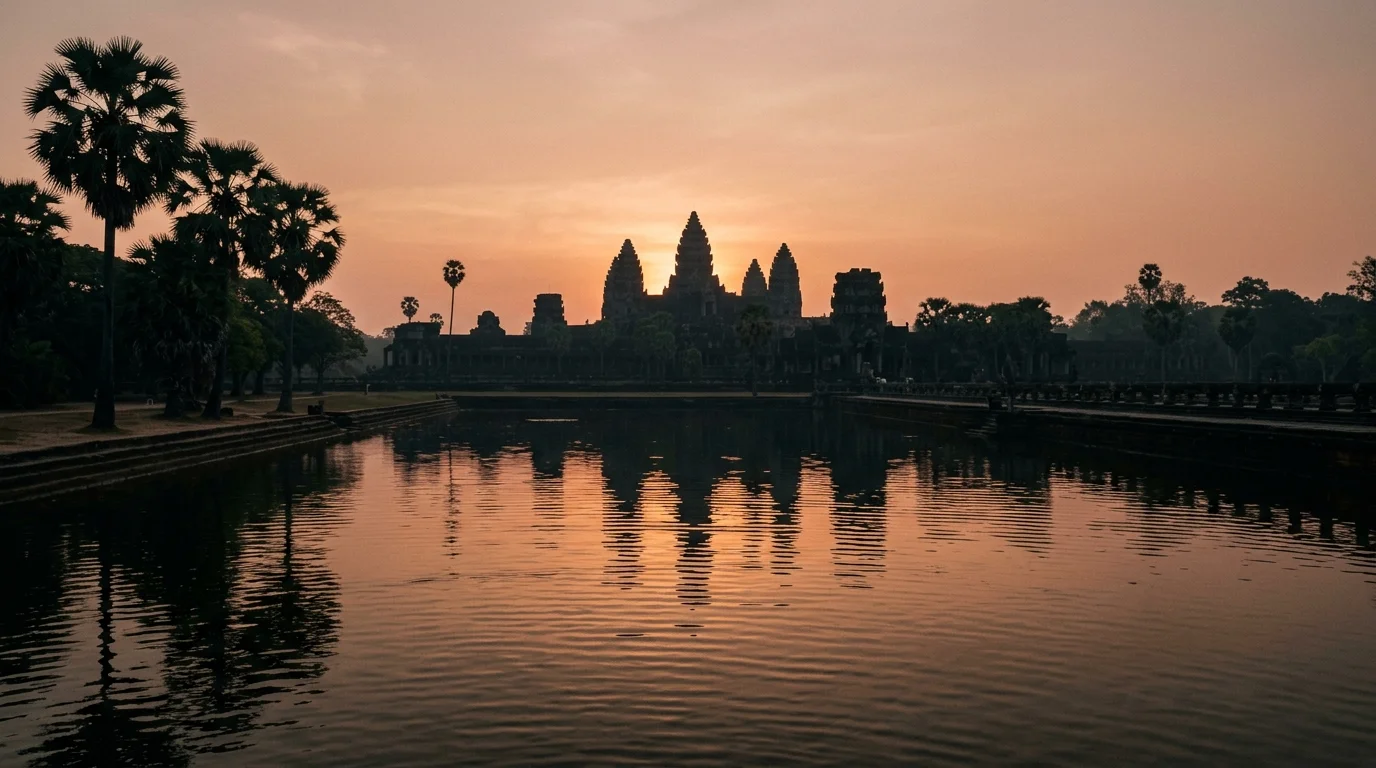
The sun came up over Angkor Wat slowly, the way sunrises work better in practice than in photography.
The sky went pink, then orange, then the silhouette of the temple complex emerged from the dark in stages: the five towers first, then the long causeway, then the moat reflecting everything back doubled. I was standing in a crowd of maybe two hundred people who had all gotten up at 4:30am for exactly this, and for a few minutes nobody said anything.
Then someone’s camera shutter went off and someone else’s phone started a notification alert and we all remembered we had devices, and the moment became a photo.
But for those first few minutes. That was something.
Angkor: how to do it without doing it wrong
Angkor Archaeological Park covers 400 square kilometres and contains the ruins of several Khmer capitals from the 9th to the 15th centuries. It’s one of the largest religious monument complexes in the world. Angkor Wat itself is the largest single religious structure on earth, built in the 12th century as a Hindu temple and gradually converted to Buddhism.
This context matters, because it changes what you’re looking at from “impressive old buildings” to “what remains of an entire civilisation at its peak.”
Three-day pass. The options are one, three, or seven-day passes. Three days is the right amount if you want to see the main sites properly rather than in a rush. The first day does the famous highlights; the second goes deeper into the complex and the outer temples; the third is for what you missed or want to see again.
Angkor Wat at sunrise. Yes, with the crowds. Go anyway. The experience in those first twenty minutes justifies every other person who had the same idea.
Angkor Thom and the Bayon. The walled city that was the Khmer capital before Angkor Wat. The Bayon temple in the centre has 54 towers, each carved with four large faces on every side. Standing in the middle of the Bayon, surrounded by faces looking in all directions from above, is genuinely strange and striking. Go mid-afternoon when the crowds are lighter.
Ta Prohm. The temple the jungle grew over, used in Tomb Raider, now managed as a permanent display of nature vs structure. The trees that have grown through the walls and roofs and courtyards over centuries have been left in place deliberately. It’s atmospheric and specific. Go early or late to avoid the tour groups.
Get a tuk-tuk driver for the day. The standard approach, and the right one. A good driver will know which temples are less crowded at what times of day, will have opinions on the best breakfast spots, and will wait outside each temple with your bags. A full-day circuit costs around $15-20 USD. Ask your guesthouse for recommendations or find one at the market.
Siem Reap: the town outside the temples
Siem Reap itself is small, built around a night market and a street called Pub Street that exists to sell cheap food and cheap beer to people who’ve been walking around ruins all day. This is not a criticism. It does what it does well.
The night market. Artisans Angkor sells crafts and textiles made by Cambodian artisans, with verified fair-trade production. Worth browsing and worth spending money in. The prices are higher than the main market but the quality is different and the chain of production is legible.
Khmer food. Cambodia’s cuisine gets overshadowed by its Thai and Vietnamese neighbours. It shouldn’t. Amok is the signature dish: fish or chicken steamed in banana leaf with coconut milk, lemongrass, galangal, and kaffir lime leaves, producing something between a curry and a custard. Lok lak is stir-fried beef or chicken with a sauce of black pepper and lime, served over rice with a fried egg. Nom banh chok: Khmer noodles, eaten for breakfast, thin rice noodles under a green herb-based sauce with sliced vegetables. Ask for it at a market stall at 7am.
Phnom Penh: the capital that carries a lot
Three hours from Siem Reap by bus or a short flight. Phnom Penh is bigger, more chaotic, less polished than Siem Reap, and contains some of the most important and difficult history in Southeast Asia.
The Tuol Sleng Genocide Museum (S-21). The former Khmer Rouge detention and torture facility, now a museum and memorial. Cambodia under the Khmer Rouge (1975-1979) lost an estimated 1.7 to 2.5 million people to execution, starvation, forced labour, and disease. Tuol Sleng is the primary site where this history is documented and preserved. It’s not an easy visit. Go anyway. Understanding Cambodia means understanding this.
Choeung Ek. The killing field 15km south of Phnom Penh. More than 8,000 remains were excavated from mass graves here. A stupa filled with skulls and bones stands at the centre of the site. The audio tour is well-produced and doesn’t soften what happened. Give it the time it deserves.
The Royal Palace. Silver Pagoda. Mekong riverfront. These exist and are worth seeing, but they will feel different after the museum. That’s as it should be.
The food markets. Central Market (Phsar Thmei) and Russian Market (Phsar Tuol Tom Poung) are the main ones. Stalls selling fresh food, cooked food, fabrics, hardware, electronics. Eat breakfast at a food stall in the market for the full experience.
Kampot: the pace changes here
Five hours south of Phnom Penh, on the river near the Gulf of Thailand. Kampot is the antidote to temples and history.
A small river town with a colonial-era main street, pepper plantations in the surrounding hills (Kampot pepper is famous and the quality you taste here versus the exported kind is significant), and a general atmosphere of nothing urgent happening.
The Bokor Hill Station: a French colonial hill station abandoned in the 1940s, then again in the 1990s, now partly reoccupied as a casino and resort, which sounds grim but the drive up through the cloud forest to the ruins of the old town is genuinely atmospheric. The original Catholic church on the summit has been left largely intact. Wind, fog, abandoned buildings, a functioning casino next door: Cambodia in miniature.
Kampot pepper. Buy it here. The black pepper is extraordinary. The green pepper (picked before drying) is softer and more aromatic and not easy to find outside the region. Take more than you think you’ll want. Kampot Pepper Promotion Association has certified farms.
The boats. River boats go into the mangroves and along the coast to Rabbit Island (Koh Tonsay). The island is small, basic accommodation on the beach, hammocks, no Wi-Fi, exactly what you want for two nights.
The practical things
USD everywhere. Cambodia’s official currency is the riel but the economy runs on US dollars. Change is given in a mix of USD and riel. ATMs dispense dollars. Bring crisp, undamaged notes; some places won’t accept worn bills.
Tuk-tuks. The main way to get around. Negotiate the price before you get in. Shorter distances should be around $2-3; longer trips $5-8. In Siem Reap, tuk-tuk apps (PassApp, Grab) have metered fares that reduce negotiation.
The heat. Hot and humid year-round. The dry season (November to April) is the easier time to travel. March and April are the hottest months. The wet season (May to October) brings daily afternoon rain and fewer tourists; the Angkor temples in light morning rain are actually beautiful, if you’re prepared for it.
Connectivity. 4G coverage in Siem Reap, Phnom Penh, and Kampot is decent. Rural coverage is thinner. Local SIMs from Metfone or Smart Axiata are cheap (a few dollars for a week of data) and available at the airport and in town. If you’re travelling through multiple Southeast Asian countries and want to avoid buying a SIM in each, an eSIM covering the region is a reasonable option. My Southeast Asia eSIM guide breaks down the current options.
What Cambodia stays as
Cambodia is a country that has experienced something most tourists can’t fully imagine, in living memory, and it is still figuring out what it is on the other side of that.
The ruins are extraordinary. The food is excellent and underrated. Kampot is one of the most enjoyable slow-travel destinations I’ve found in Southeast Asia. The people I met were warm in a way that made the history feel more complicated, not less.
You will leave Angkor Wat with a hundred identical sunrise photos and the memory of those few minutes before anyone’s phone went off.
Keep both.
More from the region